There is a noticeable difference between people who panic when faced with a financial setback and those who handle the situation with confidence. More often than not, the difference is not their income level—it is preparation. Two people can earn the same salary every month, yet one struggles to recover from an unexpected expense while the other continues paying bills without disrupting their daily life.
Preparation begins with knowing exactly how much money you should have available before a financial emergency occurs. Unfortunately, many people either save too little because they underestimate their living expenses or save an unrealistic amount that is difficult to maintain. Neither approach is ideal.
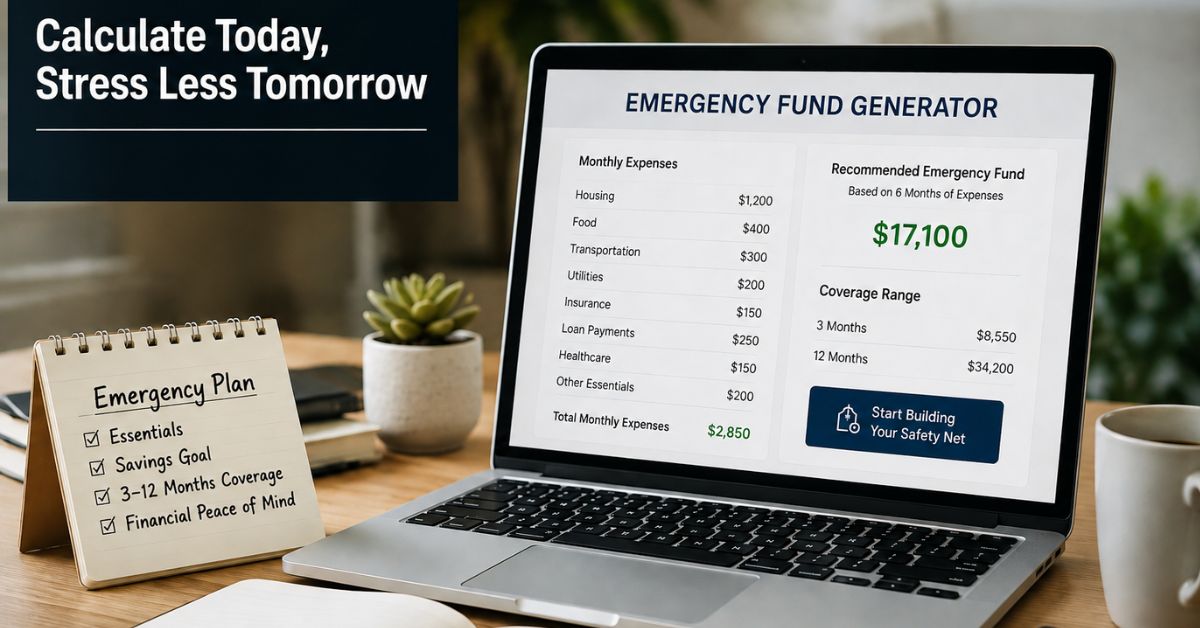
This is where an emergency fund generator becomes valuable. Instead of asking you to guess a target, it uses your actual monthly financial commitments to calculate a savings goal that reflects your current lifestyle. Whether you are employed, self-employed, running a small business, or managing a household, having a personalised savings target makes planning much easier.
In this guide, you will learn how an emergency fund generator works, how to calculate the right emergency savings based on your monthly expenses, the factors that affect your ideal savings goal, and practical ways to build your fund without placing unnecessary pressure on your budget.
The Four Numbers Every Emergency Fund Generator Needs
An emergency fund generator is only as accurate as the information you provide. Before using one, gather four key figures that paint a clear picture of your financial life.
Your Essential Monthly Expenses
This is the foundation of every calculation. Focus only on expenses that would continue even if your income stopped. These usually include housing, food, transportation, utility bills, healthcare, insurance, loan repayments, school fees, and internet services if they are necessary for work or education.
Leave out luxury spending such as vacations, premium streaming subscriptions, frequent dining out, or impulse shopping. The goal is to determine what it costs to maintain your basic standard of living.
Your Income Stability
Someone with a permanent salaried position generally faces less income uncertainty than a freelancer, commission-based salesperson, seasonal worker, or entrepreneur. A good emergency fund generator factors in this difference by recommending a longer savings period for people with less predictable earnings.
Your Household Responsibilities
A single professional living alone may only need to account for personal expenses, while a parent supporting children, elderly relatives, or a spouse has more financial obligations. Each dependent increases the amount of money required to stay financially secure during an emergency.
Existing Financial Commitments
Monthly debt repayments, business loans, hire purchase agreements, or recurring medical expenses should always be included. Ignoring them can leave your emergency fund far below what you would actually need.
How to Separate Essential Expenses From Lifestyle Spending
One of the biggest mistakes people make is counting every monthly expense when calculating their emergency savings target. During a financial emergency, your spending habits usually change.
Imagine your monthly expenses look like this:
- Rent or mortgage
- Groceries
- Electricity
- Fuel or transport
- Internet
- Insurance
- Gym membership
- Weekend outings
- Streaming platforms
- Daily coffee purchases
Only the expenses that are necessary for maintaining your household should be included in your emergency fund calculation. Lifestyle expenses can often be reduced or paused temporarily while you recover financially.
This distinction helps produce a more realistic savings goal that is challenging but achievable.
A Simple Formula You Can Calculate Yourself
Even if you do not have access to an online emergency fund generator, you can estimate your savings target using a straightforward formula.
Step 1: Add all your essential monthly expenses.
Suppose your monthly costs are:
- Rent – ₦120,000
- Food – ₦75,000
- Utilities – ₦30,000
- Transport – ₦35,000
- Insurance – ₦20,000
- Loan repayment – ₦40,000
Your total monthly essential expenses would be:
₦320,000
Step 2: Decide how many months of protection you want.
Three months: ₦320,000 × 3 = ₦960,000
Six months: ₦320,000 × 6 = ₦1,920,000
Nine months: ₦320,000 × 9 = ₦2,880,000
This figure becomes your emergency fund goal.
The advantage of using a generator is that many tools automate these calculations and allow you to adjust different scenarios within seconds.
Why Two People With the Same Salary May Need Different Emergency Funds
Income alone should never determine your emergency savings target.
Consider two employees earning ₦500,000 each month.
The first lives with family, has no loans, and spends about ₦180,000 monthly.
The second rents an apartment, pays school fees, supports parents, and has monthly loan repayments totaling ₦380,000.
Although both earn the same salary, their emergency fund requirements are dramatically different.
An effective emergency fund generator focuses on spending patterns rather than income because expenses determine how much money you need to survive during an interruption in earnings.
Choosing the Right Savings Timeline
There is no universal rule that applies to everyone. Your ideal emergency fund depends on your financial situation and career path.
Three Months
Suitable for people with highly stable employment, multiple sources of household income, and relatively low monthly expenses.
Six Months
A practical target for many families and professionals. It provides enough time to recover from job loss, illness, or other temporary financial disruptions.
Nine to Twelve Months
Recommended for entrepreneurs, freelancers, consultants, contract workers, and anyone whose income changes significantly throughout the year.
Longer savings periods also provide greater peace of mind during economic uncertainty.
Build Your Emergency Fund in Milestones
Looking at a target of ₦2 million or more can feel overwhelming. Instead of focusing on the final amount, divide your journey into smaller milestones.
For example:
- First milestone: Save one month’s expenses.
- Second milestone: Reach three months of expenses.
- Third milestone: Increase to six months.
- Final milestone: Extend to nine or twelve months if necessary.
Celebrating each milestone keeps you motivated and makes the overall goal feel more achievable.
When Should You Increase Your Emergency Fund?
Your savings target should not remain the same forever. Review your emergency fund whenever you experience major life changes such as:
Moving to a More Expensive Home
Higher housing costs increase your monthly financial obligations.
Marriage
Combining finances introduces additional responsibilities that should be reflected in your emergency savings.
Having Children
Children bring new recurring expenses, including healthcare, childcare, education, and daily living costs.
Starting a Business
Business owners often experience fluctuations in income, making a larger emergency fund advisable.
Taking on New Loans
Any new financial commitment increases the amount you need to cover if your income is interrupted.
Common Miscalculations That Leave People Underprepared
Even with an emergency fund generator, mistakes can happen if the information entered is incomplete. Some of the most common errors include:
- Forgetting annual expenses that can be converted into monthly averages.
- Ignoring insurance premiums.
- Excluding debt repayments.
- Using estimated expenses instead of actual figures.
- Calculating based on income instead of essential spending.
- Failing to update calculations after major lifestyle changes.
Reviewing your numbers every six to twelve months helps keep your savings target accurate.
How to Reach Your Savings Goal Without Feeling Overwhelmed
Many people believe they need a large salary before they can build an emergency fund. In reality, consistency matters far more than the amount of each deposit.
A practical strategy is to treat emergency savings like a recurring monthly bill. Decide on a fixed amount and transfer it to your savings account as soon as you receive your income.
If your earnings vary, commit to saving a percentage instead of a fixed amount. For example, setting aside 10% or 15% of every payment allows your savings to grow regardless of income fluctuations.
You can also accelerate your progress by directing bonuses, tax refunds, freelance income, or profits from side hustles into your emergency fund instead of increasing discretionary spending. The objective is not to save everything at once but to develop a habit that steadily moves you closer to your target.
Signs Your Emergency Fund Is Working
You may wonder how to know if your emergency fund is truly serving its purpose. A healthy emergency fund allows you to:
- Pay essential bills even if your income stops temporarily.
- Handle medical emergencies without relying entirely on loans.
- Cover urgent home or vehicle repairs.
- Avoid withdrawing money from long-term investments.
- Make career decisions based on opportunity rather than financial desperation.
When your emergency savings provide these advantages, they have become more than just money in a bank account—they have become financial security.
Final Thoughts
The best emergency fund generator does more than produce a number on a screen. It gives you a realistic picture of what financial stability looks like based on your own circumstances. Instead of relying on guesswork or copying someone else’s savings goal, you can build a plan around the expenses that truly matter in your life.
Remember that your emergency fund is not meant to grow overnight. It is built through regular, intentional saving and reviewed whenever your financial situation changes. By understanding your monthly obligations, setting achievable milestones, and adjusting your target as your responsibilities evolve, you create a safety net that supports you through life’s uncertainties.
The most important step is not finding the perfect calculator—it is using the information it provides to start saving consistently. Every contribution, whether large or small, brings you closer to greater financial confidence and long-term peace of mind.