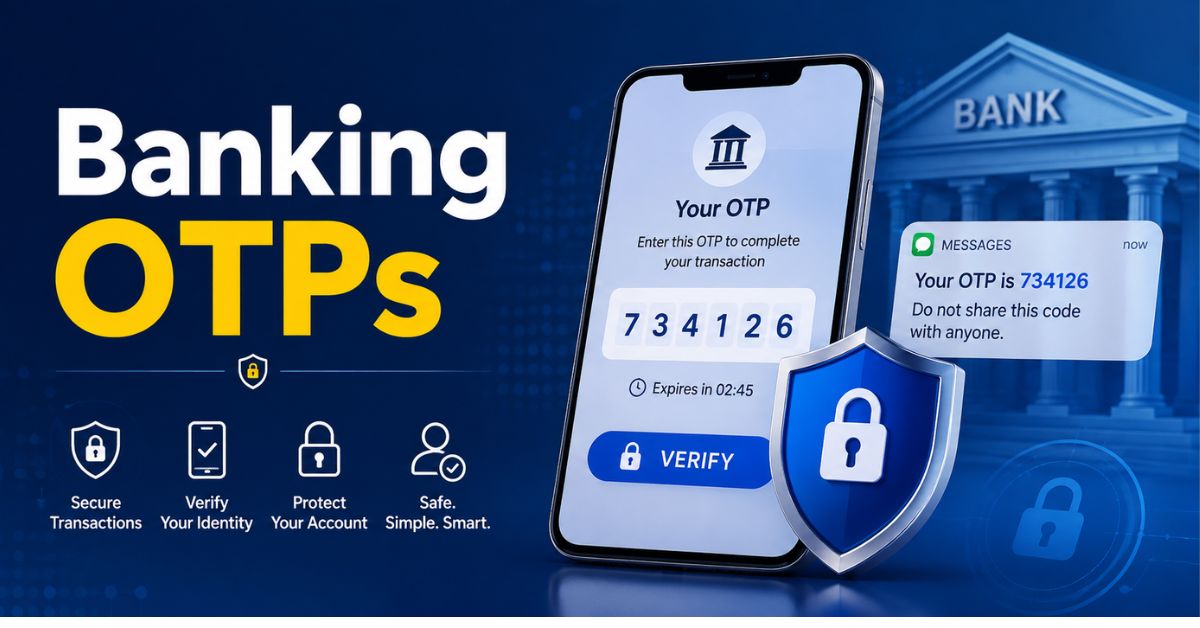
You are about to make a bank transfer, pay for something online, or log in to your banking app when a six-digit number suddenly appears on your phone. The message usually says something like “Your OTP is…”, followed by a warning not to share the code with anyone.
That small number may only remain valid for a few minutes, but it can be one of the most important security barriers protecting your bank account.
This is where OTP banking codes come in. One-Time Passwords, commonly called OTPs, have become a normal part of modern banking. Customers use them for transactions, card payments, online banking, account registration, password resets and other sensitive activities. But many people enter an OTP without really understanding what happens behind the scenes.
Who creates the code? Why does it expire? How does the bank know that the code sent to your phone is the correct one? And why is a code that looks completely random so important?
Understanding these questions makes it easier to recognize suspicious messages and protect your money from fraud.
What Is an OTP Banking Code?
An OTP, or One-Time Password, is a temporary security code generated for a particular authentication or transaction request. Unlike your regular banking password or PIN, an OTP is not intended for repeated use. It is usually valid for a limited period or a specific transaction.
For example, after initiating an online transaction, your bank may send:
“Your OTP is 483921. Do not share this code with anyone.”
You enter the code into the appropriate banking page or application. The bank then checks whether the code is valid before allowing the requested action to continue.
The exact format varies between financial institutions. Many banking OTPs contain six digits, but some systems may use different lengths or authentication methods.
The central idea remains the same: the code is temporary and should only be used by the authorized customer.
Why Do Banks Use OTPs?
Digital banking has made financial services much more convenient. Customers can transfer money, pay bills, shop online and manage their accounts without visiting a bank branch. Unfortunately, convenience also creates opportunities for fraud.
A criminal could obtain someone’s username, password or other account information through phishing, malware, fake websites or social engineering. An additional authentication step makes it harder for the criminal to complete certain sensitive activities using stolen information alone.
This is why OTPs are commonly used as an additional security layer. A bank may require you to provide your password to access an account and then request an OTP before allowing a sensitive transaction.
The OTP therefore works as a temporary confirmation that adds another barrier between an unauthorized person and your account.
How Do Banks Generate OTP Codes?
The generation of an OTP is not simply a computer picking random numbers and sending them to your phone. Banks use specialized authentication systems and cryptographic algorithms to generate and validate temporary codes. The exact technology differs from one financial institution to another, but the general process follows a familiar pattern.
1. You Initiate an Action
The process begins when you perform an activity that requires additional verification. This could include:
- Making a bank transfer
- Paying for an online purchase
- Adding a new beneficiary
- Changing certain account information
- Resetting a password
- Registering a device
- Signing into a protected service
The bank’s system identifies the request and determines that additional authentication is required.
2. The Authentication System Creates a Challenge
The bank’s security system processes information associated with your authentication request. Depending on the type of OTP system being used, this may involve a secret value associated with your account, a time value, a transaction reference or other security information.
This information is processed using a secure algorithm to produce an authentication code. The important point is that the bank does not simply rely on an ordinary list of random numbers.
3. A Temporary Code Is Generated
The authentication system produces the OTP, which may be a six-digit number. For a time-based OTP, the code can be generated using a shared secret and the current time. Because the calculation changes over time, the resulting code also changes.
For a transaction-based OTP, the code may be connected to a particular transaction or authentication request. This makes the code useful for a limited purpose instead of becoming another permanent password.
4. The Code Is Delivered to You
Once generated, the OTP is delivered through an authentication channel supported by the bank. Depending on the institution and its security system, this could be:
- SMS
- A banking application
- An authenticator application
- A hardware security token
- An in-app authentication system
- Another approved security method
SMS is one of the most familiar methods because it is convenient and does not require customers to install additional authentication software. However, banks are increasingly using multiple authentication methods as digital fraud becomes more sophisticated.
5. The Bank Verifies the Code
After receiving the OTP, you enter it into the relevant banking application, website or payment interface. The bank’s authentication system checks whether the submitted code is the expected one and whether it is still valid.
If the code matches and has not expired, the authentication can succeed . If it is incorrect, expired or associated with an invalid request, the bank can reject it.
Why Does an OTP Expire?
One of the main advantages of an OTP is that it does not remain useful forever. Imagine receiving a banking security code that remained valid for several days. If someone gained access to the message later, that code could potentially become useful to them.
Short validity periods reduce this risk. Depending on the bank’s system, an OTP may expire after a certain number of minutes, after it has been successfully used, or when the transaction associated with it is cancelled or expires.
Time-based authentication systems may also generate a completely different code after a defined interval. This explains why an OTP you received several minutes ago may stop working even though you have not used it.
Are All OTPs Generated the Same Way?
No, different banks and financial services can use different OTP technologies.
Time-Based OTP
A Time-Based One-Time Password, often referred to as TOTP, changes according to time. The authentication system and the authorized authentication application or device use synchronized information to calculate or verify the code.
Because the code changes regularly, an old code becomes useless after its validity period.
Event-Based OTP
An event-based OTP can be generated following a specific event, such as activating a security token or initiating an authentication process. The code is intended for limited use rather than becoming a permanent credential.
Transaction-Specific OTP
Some authentication systems connect an OTP to a particular transaction. For example, a code may be generated for a specific payment or transfer rather than being a general login code.
This can provide another layer of protection because the authentication is associated with a particular action.
SMS OTP
With SMS authentication, the bank sends the temporary code to the phone number registered with the account.
This remains a familiar option for many customers, although SMS-based authentication can face risks such as phone-number takeover and social engineering.
What Happens When You Enter the Wrong OTP?
When you submit an OTP, the bank checks it against the value expected by its authentication system. If the code is incorrect, the transaction or authentication attempt may be rejected.
Banks may also limit the number of incorrect attempts. Repeated failures could result in a temporary restriction or require another verification step. This is why you should not keep entering random numbers if an OTP does not work. Instead, check that you are using the most recent code and request a new one if necessary.
Why Should You Never Share Your OTP?
Your OTP is confidential, fraudsters know that an OTP may be the final security step standing between them and a successful transaction. They may therefore try to convince customers to reveal it.
A scammer might call and say: “We detected suspicious activity on your account. Give me the OTP that was just sent so I can secure your account.”
The story may sound believable, particularly if the caller already knows your name or bank.
But providing the OTP can allow the person to complete the very transaction you are trying to prevent so never give your OTP to a stranger, caller, online contact or someone claiming to be a bank representative.
If you receive a suspicious request, end the conversation and contact your bank through an official channel.
What If You Receive an OTP You Did Not Request?
An unexpected OTP does not automatically mean that someone has successfully accessed your account. There could be a genuine mistake, such as someone entering the wrong phone number. However, you should not ignore it.
Check your banking application and review recent account activity if possible. Look for unfamiliar transfers, payments, login attempts or account changes. Most importantly, do not give the OTP to anyone who contacts you asking for it.
If you notice suspicious activity, contact your bank immediately using an official customer-service number, application or website.
OTPs Are Not the Only Security Measure
It is easy to think that an OTP is the only thing protecting a bank account, but modern banking security usually involves several layers. Depending on the financial institution, these may include:
- Passwords
- PINs
- Biometrics
- Device recognition
- Transaction limits
- Encryption
- Fraud monitoring
- Login notifications
- Account lockout controls
- OTP authentication
- Suspicious-activity detection
These measures work together to make unauthorized access more difficult. However, even sophisticated technology cannot completely protect a customer who voluntarily gives sensitive authentication information to a fraudster.
That is why customer awareness remains just as important as the technology itself.
Common Mistakes Customers Make With OTPs
Some security mistakes are surprisingly simple.
Sharing an OTP With a Fake Bank Employee
Never assume that a caller is genuine simply because they know some information about you. A legitimate-looking conversation can still be a scam.
Clicking Unknown Banking Links
Fraudsters can create websites that look almost identical to legitimate banking websites. A customer may unknowingly enter their login details and OTP into a fake page. Avoid clicking suspicious links received through unsolicited messages.
Allowing Remote Access to Your Phone
Be cautious when someone unexpectedly asks you to install an application that gives them remote access to your device.
Ignoring Transaction Notifications
Bank alerts can help customers identify suspicious activity quickly. If you receive a notification for something you did not do, investigate immediately.
Reusing Sensitive Credentials
Avoid using the same password or PIN across multiple services. If one account is compromised, reused credentials could expose other accounts as well.
What Should You Do If You Accidentally Share an OTP?
- Contact your bank immediately through an official channel and explain that you may have exposed an OTP.
- Check your account for unfamiliar transactions and follow the bank’s instructions for securing the account.
Do not wait until money disappears before reporting the incident. A quick response can give the bank an opportunity to investigate or take protective action.
The Future of Banking OTP Security
Banking authentication continues to change as fraud techniques become more advanced. Customers may increasingly see security systems that combine OTPs with device recognition, biometrics, transaction confirmation, authentication applications and behavioral fraud detection.
This could eventually reduce the need to manually enter OTPs for every transaction.
The goal is not simply to create a six-digit number. The bigger objective is to establish confidence that the person attempting to perform a transaction is genuinely authorized to do so.
Final Thoughts
An OTP banking code may look like a simple six-digit number, but it represents an important part of the security process protecting digital financial transactions.
Banks use authentication systems and cryptographic techniques to generate and verify temporary codes. These codes are deliberately designed to expire or become unusable after a particular period or transaction. But the effectiveness of OTP security also depends on the customer.
Your OTP should be treated as confidential information. Do not disclose it because someone claims to be from your bank, and never allow pressure or urgency to make you ignore basic security precautions.
If you receive an OTP you did not request, take it seriously. Check your account and contact your bank if anything appears unusual.
The safest way to think about an OTP is it is not just a number sent to your phone. It is a temporary authorization credential designed to help protect your money. Keep it private.